Profitability Reports
Understanding TRUE profitability is essential for making smart business decisions. DokanGo goes beyond simple revenue minus cost calculations to show you the complete picture of what you're actually earning after all expenses.
TRUE Profitability Concept
Most e-commerce platforms show misleading profit numbers. DokanGo shows you the truth.
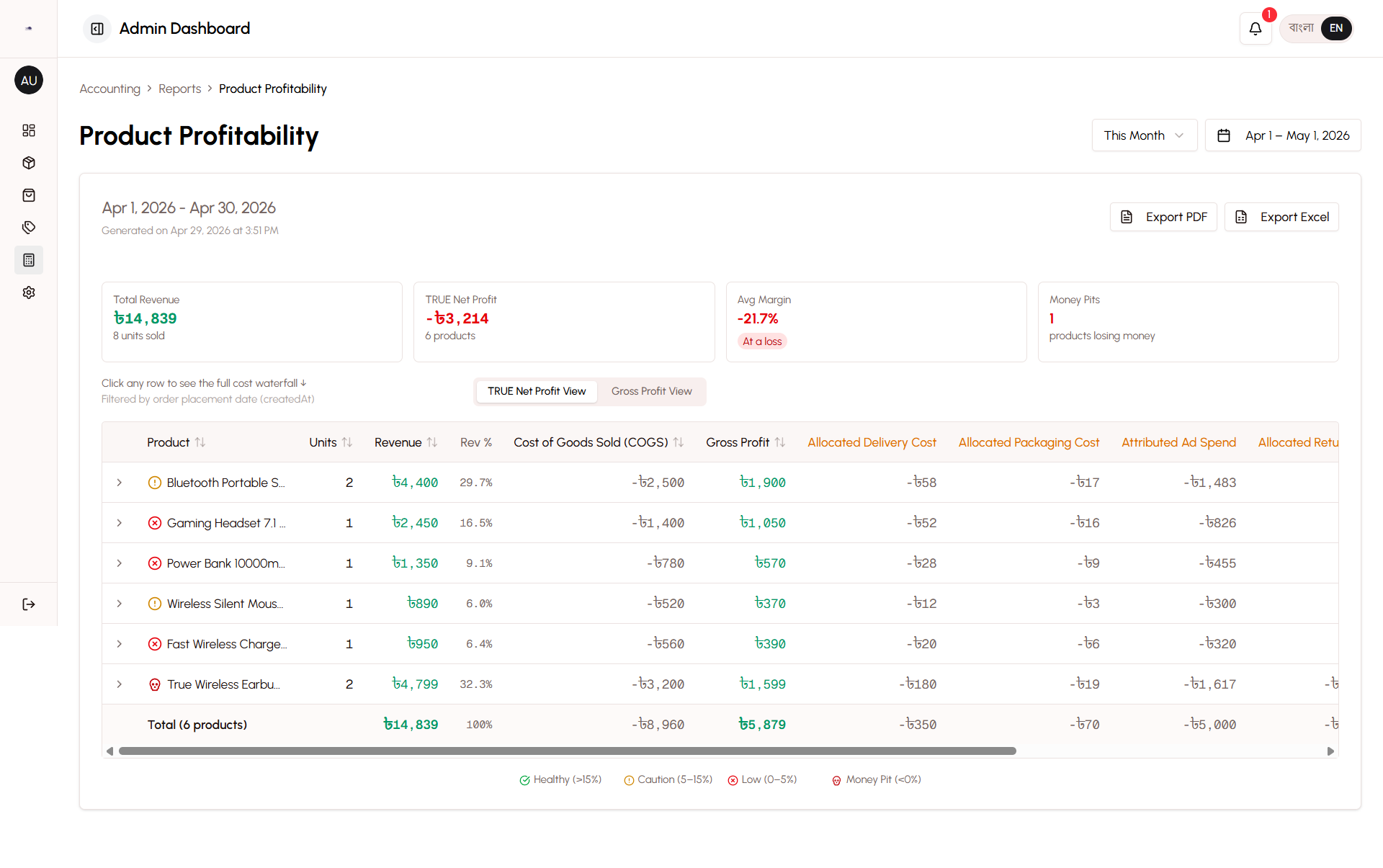
What TRUE Profitability Means
TRUE profitability includes ALL costs associated with running your business:
- Product Costs - What you paid for the items
- Delivery Costs - Fees paid to couriers
- Ad Spend - Marketing costs to acquire customers
- Return Losses - Delivery fees lost on returns and cancellations
- Payment Fees - Transaction costs (when applicable)
- Packaging Costs - Materials used for fulfillment
- Operating Expenses - Rent, utilities, salaries, etc.
Simple vs TRUE Profit Comparison
Simple Profit (Misleading):
Product sold for: 2,000 BDT
Product cost: 1,200 BDT
Simple Profit: 800 BDT (40% margin)
This looks great, but it's incomplete.
TRUE Profit (Honest):
Product sold for: 2,000 BDT
Product cost: 1,200 BDT
Delivery fee paid: 100 BDT
Ad spend allocated: 200 BDT
Packaging cost: 30 BDT
Payment processing: 20 BDT
TRUE Profit: 450 BDT (22.5% margin)
The TRUE profit is almost half the simple profit! This honest calculation helps you:
- Price products correctly
- Identify actually profitable products
- Make informed marketing decisions
- Understand real business health
Why Other Systems Get It Wrong
Most e-commerce platforms only track:
- Revenue (what customers paid)
- Product cost (what you paid suppliers)
They ignore:
- Delivery fees you pay to couriers
- Ad spend to acquire customers
- Losses from returns and cancellations
- Packaging and fulfillment costs
- Payment processing fees
This creates a false sense of profitability and leads to poor business decisions.
Product Profitability Report
See the TRUE profit for every product in your catalog, with complete cost breakdowns.
How Product Profit Is Calculated
For each product, DokanGo tracks:
Revenue:
- Total sales (quantity sold × selling price)
- Number of units sold
- Average selling price
Direct Costs:
- Product cost (frozen at checkout time)
- Delivery fees paid for orders containing this product
- Packaging costs allocated to this product
- Payment processing fees
Marketing Costs:
- Ad spend allocated based on revenue attribution
- Promotional discounts given
Return Impact:
- Revenue lost from returns
- Delivery fees lost (non-recoverable)
- Restocking costs
TRUE Profit:
TRUE Profit = Revenue - Product Cost - Delivery - Ad Spend - Returns - Packaging - FeesCost Price Tracking (Frozen at Checkout)
DokanGo uses a sophisticated cost tracking system:
When you set a product's cost price:
- The cost is stored with the product
- You can update it anytime
When a customer orders the product:
- The CURRENT cost price is frozen with that order
- This frozen cost is used for profit calculations
- Future cost price changes don't affect past orders
Why This Matters:
- Accurate historical profit tracking
- Correct profit even if supplier prices change
- Reliable profitability analysis over time
Example:
- June 1: Product cost is 500 BDT, you sell 10 units
- June 15: Supplier raises price, you update cost to 600 BDT
- June 30: You sell 10 more units
Profit calculation:
- First 10 units use 500 BDT cost (frozen at checkout)
- Last 10 units use 600 BDT cost (frozen at checkout)
- Total profit is accurate for both periods
Delivery Cost Allocation Per Product
Delivery fees are allocated to products based on their contribution to the order:
Single Product Order:
- Product bears 100% of delivery fee
Multiple Product Order:
- Delivery fee is split proportionally by product value
Example Order:
Product A: 1,000 BDT (66.7% of order)
Product B: 500 BDT (33.3% of order)
Delivery Fee: 150 BDT

Product A delivery allocation: 100 BDT (66.7% of 150)
Product B delivery allocation: 50 BDT (33.3% of 150)
This ensures each product's profitability reflects its true delivery cost.
Return Loss Impact on Product Profitability
Returns affect profitability in multiple ways:
Revenue Loss:
- Returned products reduce total revenue
- Sale is reversed in accounting
Delivery Loss:
- Delivery fee paid to courier is NOT recovered
- This is a pure loss that reduces product profitability
Restocking Cost:
- Time and effort to process return
- Inspection and repackaging
- Potential damage or unsellable condition
Example:
Product sold for: 2,000 BDT
Product cost: 1,200 BDT
Delivery fee paid: 100 BDT
Initial profit: 700 BDT

Customer returns product:
Revenue reversed: -2,000 BDT
Cost reversed: +1,200 BDT
Delivery loss: -100 BDT (NOT recovered)
Net result: -900 BDT loss

Product profitability: -900 BDT (lost money on this transaction)
The product profitability report shows return impact clearly, helping you identify products with high return rates.
Ad Spend Allocation Methodology
Ad spend is allocated to products based on attribution:
Direct Attribution:
- If you run ads specifically for a product, that product bears the full ad cost
- Example: 500 BDT ad for Product A → Product A gets 500 BDT ad cost
Proportional Attribution:
- General ads (brand awareness, store promotion) are allocated proportionally
- Allocation based on revenue contribution
Example:
Total ad spend this month: 10,000 BDT
Total revenue this month: 100,000 BDT
Ad spend rate: 10% of revenue

Product A revenue: 20,000 BDT
Product A ad allocation: 2,000 BDT (10% of 20,000)

Product B revenue: 5,000 BDT
Product B ad allocation: 500 BDT (10% of 5,000)
This methodology ensures every product's profitability reflects its marketing cost.
Payment Processing Fee Calculations
Payment processing fees (when applicable) are allocated per transaction:
Manual Payments (bKash, Nagad, Rocket):
- Currently no fees (direct customer-to-merchant transfer)
- Fee allocation: 0 BDT
Cash on Delivery:
- Courier may charge COD handling fee
- Fee allocated to the order and distributed to products
Future Payment Gateways:
- Gateway fees (typically 2-3% of transaction)
- Automatically allocated to products in the order
Geographic Profitability Report
Understand which locations are most profitable for your business.
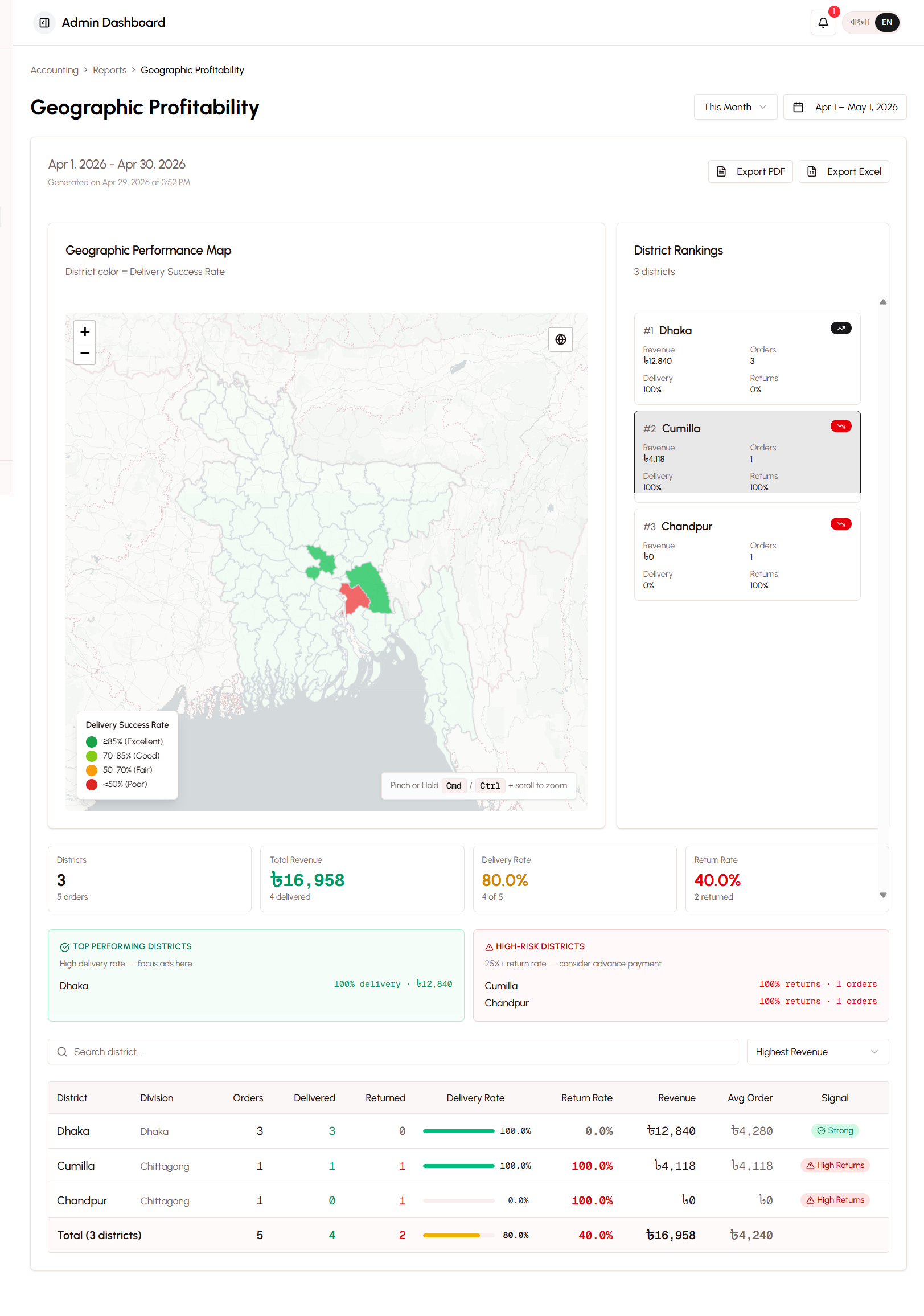
Profitability Analysis by Location
DokanGo analyzes profitability at four geographic levels:
Division Level:
- Dhaka Division
- Chittagong Division
- Rajshahi Division
- Khulna Division
- Barisal Division
- Sylhet Division
- Rangpur Division
- Mymensingh Division
District Level:
- 64 districts of Bangladesh
- Example: Dhaka, Gazipur, Narayanganj, Comilla, etc.
Upazila Level:
- Sub-district administrative units
- Example: Dhanmondi, Gulshan, Mirpur, etc.
Thana Level:
- Police station jurisdictions
- Most granular geographic analysis
For each location, see:
- Total revenue
- Total orders
- Average order value
- Total delivery costs
- Return rate
- TRUE profit
- Profit margin percentage
How Delivery Costs Vary by Location
Delivery costs significantly impact geographic profitability:
Inside Dhaka:
- Typical delivery: 60-80 BDT
- Fast delivery available
- Lower return rates
- Higher profitability
Outside Dhaka (nearby districts):
- Typical delivery: 100-130 BDT
- 2-3 day delivery
- Moderate return rates
- Good profitability
Remote Areas:
- Typical delivery: 150-200 BDT
- 4-7 day delivery
- Higher return rates (longer delivery time)
- Lower profitability
The geographic profitability report shows these differences clearly, helping you make decisions about:
- Where to focus marketing efforts
- Whether to offer free shipping in certain areas
- Pricing adjustments for different regions
- Delivery fee structures
Return Rate Impact by Geography
Return rates vary significantly by location:
Urban Areas (Dhaka, Chittagong):
- Lower return rates (5-10%)
- Faster delivery reduces buyer's remorse
- Better courier service quality
- Higher customer satisfaction
Rural Areas:
- Higher return rates (15-25%)
- Longer delivery times increase cancellations
- Less reliable courier service
- More COD refusals
Impact on Profitability:
Location A (Urban):
Revenue: 100,000 BDT
Return rate: 5%
Delivery loss from returns: 500 BDT
Net impact: -500 BDT

Location B (Rural):
Revenue: 100,000 BDT
Return rate: 20%
Delivery loss from returns: 2,000 BDT
Net impact: -2,000 BDT
Location B is significantly less profitable due to higher return rates.
Use Cases for Geographic Insights
Marketing Optimization:
- Focus ad spend on high-profit locations
- Reduce marketing in low-profit areas
- Create location-specific campaigns
Pricing Strategy:
- Adjust delivery fees by location
- Offer free shipping only in profitable areas
- Set minimum order values based on delivery costs
Inventory Planning:
- Stock products popular in high-profit regions
- Reduce inventory for low-profit areas
Expansion Decisions:
- Identify new markets with high potential
- Avoid expanding to unprofitable regions
Courier Selection:
- Choose couriers with best performance in key areas
- Negotiate better rates for high-volume locations
Customer Profitability Analysis
Understand which customers are most valuable to your business.
Lifetime Value Calculations
Customer Lifetime Value (LTV) is the total profit a customer generates over their entire relationship with your store:
LTV Formula:
LTV = (Total Revenue from Customer) - (Total Costs for Customer's Orders) - (Allocated Ad Spend)Example Customer:
Total orders: 5
Total revenue: 15,000 BDT
Total product costs: 9,000 BDT
Total delivery fees: 500 BDT
Allocated ad spend: 1,500 BDT
LTV: 4,000 BDT
This customer has generated 4,000 BDT in TRUE profit.
Average Order Value and Purchase Frequency
Average Order Value (AOV):
AOV = Total Revenue / Number of OrdersHigher AOV generally means higher profitability (fixed costs like delivery are spread over more revenue).
Purchase Frequency:
Frequency = Number of Orders / Months as CustomerHigher frequency means more loyal, valuable customers.
Customer Segments:
VIP Customers:
- High LTV (10,000+ BDT)
- High frequency (2+ orders per month)
- High AOV (2,000+ BDT per order)
- Low return rate
Regular Customers:
- Moderate LTV (3,000-10,000 BDT)
- Moderate frequency (1 order per month)
- Moderate AOV (1,000-2,000 BDT)
- Normal return rate
Occasional Shoppers:
- Low LTV (under 3,000 BDT)
- Low frequency (few orders per year)
- Variable AOV
- Variable return rate
One-Time Buyers:
- Single order only
- May have negative LTV (if high ad spend to acquire)
- Opportunity for re-engagement
Customer Segmentation by Profitability
Use profitability data to segment customers:
High-Value Segment:
- Top 20% of customers by LTV
- Focus retention efforts here
- Offer VIP perks and loyalty rewards
- Personalized service
Growth Potential Segment:
- Customers with increasing order frequency
- Recent positive experiences
- Target for upselling and cross-selling
At-Risk Segment:
- Previously active but haven't ordered recently
- Target for re-engagement campaigns
- Special offers to win back
Unprofitable Segment:
- High return rates
- Low AOV with high delivery costs
- Frequent complaints
- Consider whether to continue serving
Courier Performance Analysis
Evaluate courier services based on cost and reliability.
Courier Cost Tracking
Track total costs paid to each courier service:
- Steadfast: Total fees paid
- Other couriers: Manual entry totals
- Cost per delivery by courier
- Cost trends over time
Delivery Success Rates
Measure how reliably each courier delivers:
Success Rate:
Success Rate = Delivered Orders / Total Orders SentExample:
Steadfast:
Orders sent: 100
Successfully delivered: 92
Success rate: 92%

Other Courier:
Orders sent: 50
Successfully delivered: 40
Success rate: 80%
Higher success rates mean fewer returns and better profitability.
Return Rate by Courier
Track returns attributed to courier issues:
- Lost packages
- Damaged deliveries
- Excessive delivery delays
- Poor customer service
Impact on Profitability:
Courier A:
Delivery fee: 100 BDT
Return rate: 5%
Expected loss per order: 5 BDT

Courier B:
Delivery fee: 80 BDT
Return rate: 20%
Expected loss per order: 16 BDT
Courier A is more profitable despite higher fees due to better reliability.
Ad Performance (ROAS)
Measure the effectiveness of your advertising spend.
Return on Ad Spend Calculation
ROAS (Return on Ad Spend) measures how much revenue you generate for every taka spent on advertising:
ROAS Formula:
ROAS = Revenue from Ads / Ad SpendExample:
Ad spend: 10,000 BDT
Revenue generated: 50,000 BDT
ROAS: 5.0 (or 5:1)
For every 1 BDT spent on ads, you generated 5 BDT in revenue.
ROAS Benchmarks:
- Below 2:1 - Unprofitable (losing money)
- 2:1 to 4:1 - Break-even to modest profit
- 4:1 to 8:1 - Good performance
- Above 8:1 - Excellent performance
Ad Spend Tracking by Campaign
Track ROAS for different campaigns:
Campaign A (Facebook - Summer Sale):
Ad spend: 5,000 BDT
Revenue: 30,000 BDT
ROAS: 6:1
Status: Profitable, continue
Campaign B (Instagram - New Products):
Ad spend: 3,000 BDT
Revenue: 4,500 BDT
ROAS: 1.5:1
Status: Unprofitable, pause or optimize
Revenue Attribution to Ad Spend
DokanGo attributes revenue to ad campaigns using:
Direct Attribution:
- UTM parameters in ad links
- Promo codes specific to campaigns
- Landing page tracking
Time-Based Attribution:
- Revenue within 7 days of ad click
- First-touch attribution (first ad customer saw)
- Last-touch attribution (last ad before purchase)
Proportional Attribution:
- For general brand awareness ads
- Allocated based on timing and customer journey
This attribution helps you understand which ads actually drive sales and which are wasting money.
Best Practices
Review Profitability Weekly - Check product and geographic profitability reports weekly to spot trends early.
Focus on TRUE Profit - Don't be fooled by high revenue. Focus on what you actually keep after all costs.
Identify Loss Leaders - Some products may lose money but drive traffic. Decide if they're worth keeping.
Optimize Ad Spend - Pause campaigns with ROAS below 3:1 unless they serve strategic purposes.
Target Profitable Locations - Focus marketing on geographic areas with highest profitability.
Reward VIP Customers - Give special treatment to high-LTV customers to encourage loyalty.
Improve Courier Performance - Switch couriers if return rates are too high, even if fees are lower.
Track Cost Changes - Monitor product costs, delivery fees, and ad costs for sudden changes.
Set Profitability Goals - Aim for specific profit margins (e.g., 25% TRUE profit margin).
Use Data for Pricing - Adjust prices based on TRUE profitability, not just competitor prices.
Related Topics
- Accounting System - Understand how profitability is calculated
- Expense Tracking - Learn how expenses affect profitability
- Financial Reports - Explore detailed financial statements
- Analytics & Reporting - Dive deeper into business analytics